Challenges Infants Face in Developing Gross Motor Skills
Children with Down syndrome want to do everything their peers do — they want to sit, crawl, walk, explore their surroundings, and interact with the people around them. To do so, they need to develop their gross motor skills. However, certain physical characteristics associated with Down syndrome make it more difficult for them to develop these skills at the same pace as their peers, including low muscle tone, ligament laxity causing excessive joint flexibility, and reduced overall physical strength. As a result, they develop compensatory movement patterns, some of which can lead to long-term health complications such as chronic foot pain or an inefficient walking pattern.
Contrary to what many people assume, the goal of physical therapy is not to speed up a child's development, but to facilitate the development of optimal movement patterns. The long-term goals are to help the child develop a proper standing posture, achieve balance between the feet, establish a suitable walking pattern, and build the physical foundations needed for sports and physical activity in the future.
Core Focus Areas in a Typical Physical Therapy Session
The physical therapist begins by observing the skills the child has already mastered independently, then identifies the skills that can be learned at the next stage — focusing on what can be achieved within the coming month rather than on skills that are too advanced for the child's current abilities.
Once the appropriate skills are identified, a teaching plan is developed that involves breaking each skill down into its key components, then trying a variety of teaching strategies based on the child's individual learning style.
Perhaps the most important part of the therapist's role is teaching parents how to practise these skills with their child at home — during moments when the child feels comfortable and energetic, or by incorporating them into daily routines. Practice and repetition build strength and efficiency, ultimately leading to skill mastery.
How Does a Child's Temperament Affect Motor Development?
Temperament refers to an individual's characteristic way of thinking, behaving, and reacting. Specialists have observed that children with Down syndrome generally fall into two categories:
- Go-getters: These children tend to take risks, enjoy fast movement, embrace new movements and positions, and dislike staying still. When learning to walk, for example, they take independent steps readily and are not deterred by repeated falls.
- Observers: These children are more cautious and careful, prefer calm positions, and feel apprehensive when trying new movements. They will only attempt independent steps once they feel confident in their balance.
Understanding your child's temperament and what motivates them gives you the ability to anticipate which activities they will enjoy and which they may resist — allowing you to start with what they love and gradually move towards more challenging activities once they feel secure.
Practical Tips for Training Gross Motor Skills
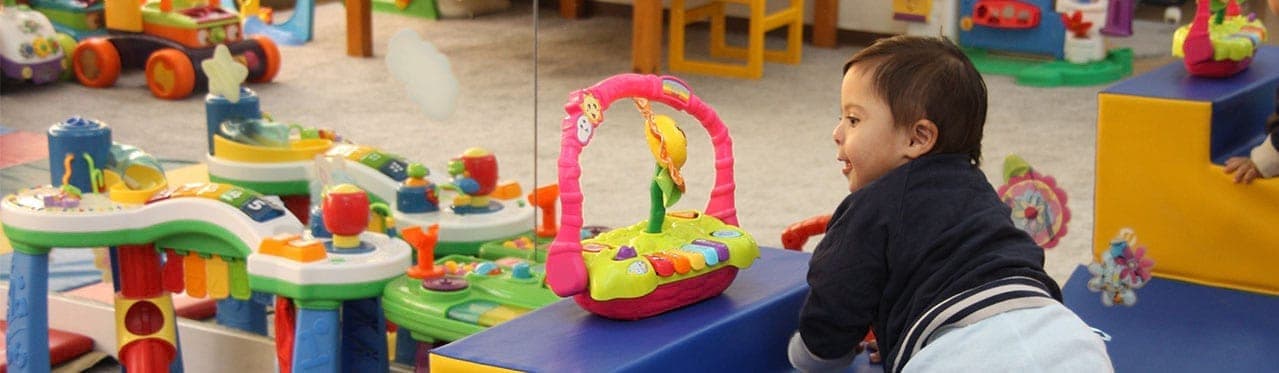
- Identify motivators: Your child is likely to move when there is something that encourages them — crawling towards a favourite toy, for instance. Choose the right toys and place them strategically to encourage movement.
- Think like your child: Consider which gross motor activities your child already enjoys and start from there. If they love lying on their tummy, teach them to roll, crawl, and climb. If they prefer sitting, work on independent sitting.
- Motivation and praise are the foundation of success: Begin with skills they show readiness to learn, and practise when they are at their most active. A short, productive session is far more valuable than an hour of unsuccessful attempts that leave everyone frustrated.
- Read their signals: If a skill seems too difficult, simplify it by adjusting how it is performed or offering more support. Do not stop a session while the child is in their best state — quality matters more than duration.
- Turn practice into play: Introduce each exercise as a game, help your child understand what to do, practise together while gradually reducing support, and continue until they can do it independently.
Children with Down syndrome have a unique learning style that deserves to be understood and respected. As psychologist Jennifer Wishart, who has written extensively on this subject, has said: "Our approaches can sometimes turn slow but willing learners into people who avoid learning altogether." Strive to make every training session an enjoyable environment where the child wants to learn — not one where they feel forced.
Source: The information in this article has been reproduced under an exclusive agreement with the National Down Syndrome Society. Available at: ndss.org